Engineering an Enterprise IDP: Self-Service Cloud Infrastructure using Backstage, ArgoCD & Crossplane

 Enterprise Cloud-Native IDP: A self-service developer portal and automated GitOps ecosystem engineered by Muhammad Zubair.
Modern software organizations face severe bottlenecks when developers are forced to wait days for DevOps teams to provision databases, configure cloud networking, or wire up CI/CD pipelines. This friction increases developer cognitive load and leads to ungoverned infrastructure drift.
To solve this, Muhammad Zubair, a Platform & DevOps Engineer specializing in Kubernetes and Cloud-Native Architecture, engineered an enterprise-grade Internal Developer Platform (IDP). This platform empowers developers with single-click self-service scaffolding while enforcing automated security guardrails and GitOps delivery behind the scenes.
The Tech Stack: Cloud-Native Platform Architecture
This project unites the industry-standard pillars of Platform Engineering into a cohesive, self-healing developer platform running on AWS:
| Layer                   | Technology Used                  | Purpose                                                        |
| :---------------------- | :------------------------------- | :------------------------------------------------------------- |
| **Developer Portal**    | Spotify Backstage, PostgreSQL    | Single pane of glass, software catalog, and Golden Path templates |
| **GitOps Automation**   | ArgoCD (ApplicationSets)         | Dynamic directory discovery, zero-touch tenant sync, auto-healing  |
| **Policy as Code**      | Kyverno                          | Admission control validation, cost tracking, and security bouncer  |
| **Cloud Control Plane** | Crossplane (Upbound AWS)         | Managing live AWS S3 storage via declarative Kubernetes YAML   |
| **Orchestration Host**  | Kubernetes (k3s), AWS EC2 (gp3)  | Lightweight, production-grade container orchestration runtime  |
Engineering Overview & Architectural Spotlight
1. Zero-Touch GitOps with Dynamic ApplicationSets
Instead of manually configuring an ArgoCD pipeline every time a new microservice is born, I engineered an automated ApplicationSet leveraging Git directory generators.
Whenever a developer or template commits a new microservice directory under apps/*, ArgoCD automatically discovers it, isolates it into a dedicated Kubernetes namespace, and initiates continuous reconciliation.
# Dynamic GitOps Auto-Discovery Rule
apiVersion: argoproj.io/v1alpha1
kind: ApplicationSet
metadata:
  name: dynamic-apps-generator
  namespace: argocd
spec:
  generators:
  - git:
      repoURL: https://github.com/Muhammad-Zubair796/cloud-native-idp.git
      revision: main
      directories:
      - path: apps/*
  template:
    metadata:
      name: '{{path.basename}}'
    spec:
      project: default
      source:
        repoURL: https://github.com/Muhammad-Zubair796/cloud-native-idp.git
        targetRevision: main
        path: '{{path}}'
      destination:
        server: https://kubernetes.default.svc
        namespace: '{{path.basename}}'
      syncPolicy:
        automated:
          prune: true
          selfHeal: true
2. Policy-as-Code Guardrails with Kyverno
Self-service without guardrails leads to cloud chaos. To establish automated governance, I implemented a cluster-wide Kyverno Policy acting as an admission controller at the cluster door.
The policy strictly audits workloads: if an engineer attempts to deploy an application without a valid team ownership tag for cost accounting, Kyverno blocks the admission request immediately before execution.
# Admission Control Enforcing Cost-Allocation Labels
apiVersion: kyverno.io/v1
kind: ClusterPolicy
metadata:
  name: require-team-label
spec:
  validationFailureAction: Enforce
  background: false
  rules:
  - name: check-team-label
    match:
      any:
      - resources:
          kinds:
          - Pod
          namespaces:
          - default
    validate:
      message: "BLOCKED: Every pod in the default namespace MUST have a 'team' label for cost tracking!"
      pattern:
        metadata:
          labels:
            team: "?*"
3. Declarative Cloud Provisioning via Crossplane
Developers shouldn't need AWS IAM console access or Terraform expertise to request storage.
Using Crossplane, I extended the Kubernetes API into a cloud control plane. By authenticating Crossplane with an AWS ProviderConfig, developers can provision and reconcile live Amazon S3 buckets entirely through simple Kubernetes custom resources.
# Declarative AWS S3 Bucket Reconciled in Real-Time
apiVersion: s3.aws.upbound.io/v1beta1
kind: Bucket
metadata:
  name: idp-test-bucket-zubair-26812
spec:
  forProvider:
    region: us-east-1
4. Developer Experience & Catalog Ingestion (Spotify Backstage)
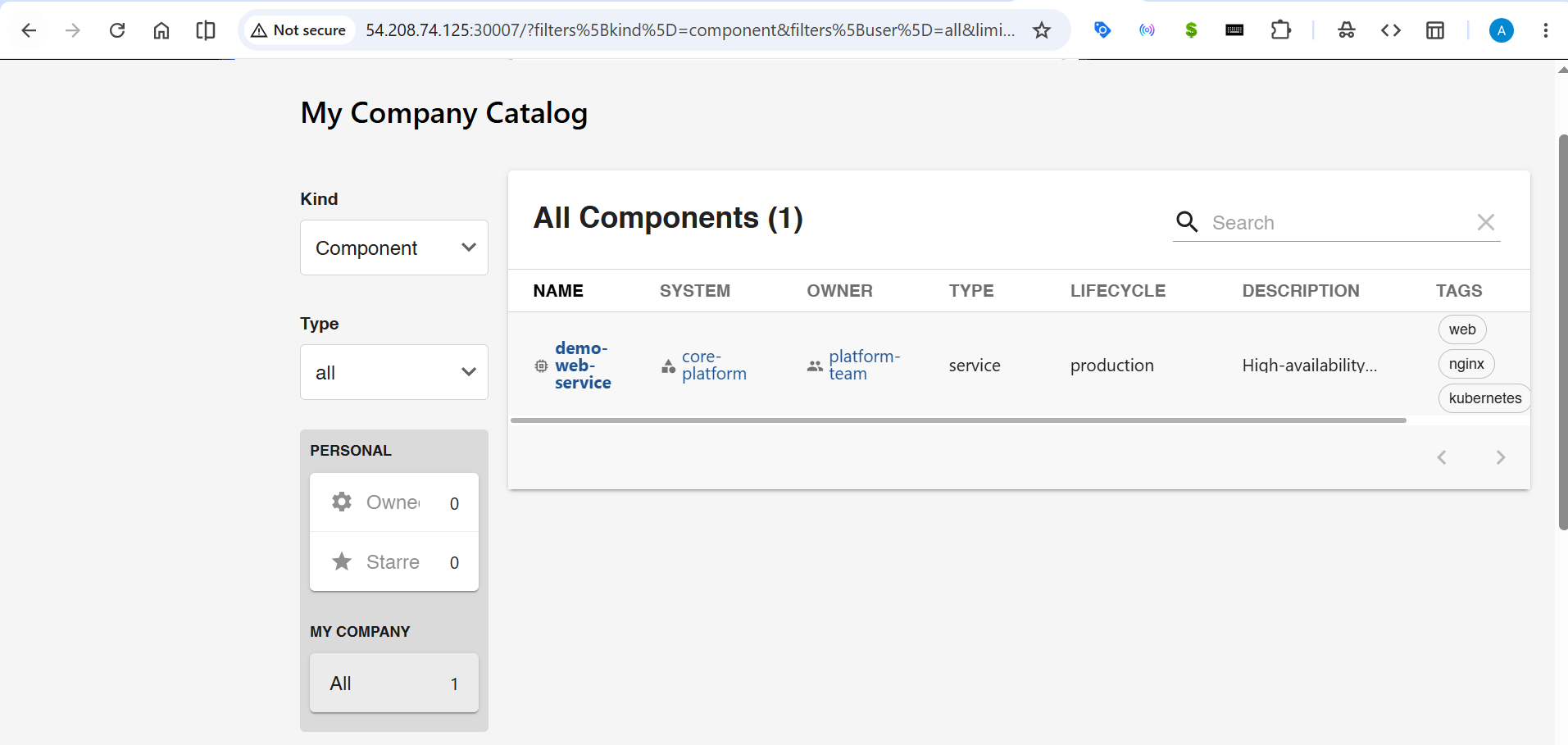
At the center of the platform is Spotify Backstage, backed by an isolated PostgreSQL database.
Backstage continuously ingests declarative catalog-info.yaml files from Git, providing teams with an interactive visual dependency graph, ownership metadata, lifecycle tracking (production vs. experimental), and access to "Golden Path" software scaffolding templates.
The Business Impact of Platform Engineering
This Internal Developer Platform bridges the gap between infrastructure stability and developer velocity:
- Zero Infrastructure Bottlenecks: Developers spin up compliant microservices and cloud resources in seconds without submitting DevOps support tickets.
- Security & Compliance by Default: With Kyverno embedded at the control plane level, non-compliant or untracked workloads are rejected before they ever reach production.
- Unified Developer Experience: Engineers interact with one intuitive interface (Backstage) while Kubernetes, ArgoCD, and Crossplane reliably handle the heavy lifting.
 About the Developer
I am Muhammad Zubair, a Software, DevOps & Platform Engineer from Pakistan passionate about building scalable Internal Developer Platforms, Kubernetes architectures, and AI Infrastructure.
- GitHub: Muhammad Zubair's Repositories
- Portfolio: mzubair.online
- Project Repository: cloud-native-idp